TL;DR: Radon is a naturally occurring radioactive gas that has become the leading cause of lung cancer in non-smokers, affecting approximately 1 in 5 Canadian homes. Professional indoor air quality testing is the only reliable way to identify if your home exceeds safety guidelines and to implement a scientific plan for a healthier living environment.
Is there a silent roommate living in your basement that you didn’t invite? Most Canadians are familiar with the big names in home hazards: asbestos, lead, and mould: but there is an invisible, odorless, and tasteless guest that is arguably more dangerous because you can’t see it coming. Radon gas is a natural part of our Canadian landscape, but when it hitches a ride into your home through the foundation, it transforms from a geological quirk into a serious health crisis.
What exactly is radon and how does it enter my home?
Radon is a radioactive gas produced by the natural breakdown of uranium in soil and rocks. Since Canada sits on a massive amount of uranium-rich earth, this gas is constantly seeping out of the ground and looking for a place to go. When it finds a building, it enters through cracks in foundation walls, floor drains, sump pumps, or gaps around service pipes because the air pressure inside your home is typically lower than the pressure in the soil.

Think of your home like a giant vacuum. It sucks air in from the bottom, and if that soil air happens to be rich in radon, your basement becomes a collection chamber. Unlike outdoor air where radon is diluted to safe levels, the confined spaces of a modern, energy-efficient home can trap the gas, allowing concentrations to reach dangerous levels. This is a classic building science problem where airtight construction, while great for your heating bill, can sometimes work against your indoor air quality if not properly managed.
Why should Canadians be concerned about radon levels?
Radon is the second leading cause of lung cancer overall and the primary cause for non-smokers, contributing to more than 3,200 deaths in Canada every year. Recent studies indicate that roughly 1 in 5 Canadian homes contain radon levels that exceed federal safety guidelines, making it a widespread public health issue. Because you can’t smell or taste it, the only way to know your risk is through dedicated environmental testing services.
The statistics are sobering. In some regions of the country, the prevalence is even higher than the national average. If you are a smoker, the combined risk of radon exposure and tobacco use is astronomical: your chances of developing lung cancer jump significantly. But even if you’ve never touched a cigarette, long-term exposure to high radon levels is like getting a chest X-ray every single day. At Built Environments Canada, we believe that peace of mind shouldn't be a luxury; it should be the standard for every homeowner.
What does the 200 Bq/m³ guideline actually mean?
The 200 Bq/m³ (becquerels per cubic metre) threshold is the action level set by Health Canada, indicating the point at which homeowners should take steps to reduce radon concentrations. While the World Health Organization (WHO) suggests a more conservative target of 100 Bq/m³, Canada’s guideline is designed to balance health risks with the practicalities of home mitigation. If your home tests above this level, Health Canada recommends taking corrective action within one to two years, depending on how high the reading actually is.

It is important to understand that "under 200" doesn't mean "zero risk." Just like there is no "safe" number of cigarettes to smoke, there is no "safe" level of radiation. However, the 200 Bq/m³ mark is where the statistical risk of lung cancer begins to climb sharply. Our team of Certified Industrial Hygienists uses this guideline as a baseline, but we always aim for the lowest levels achievable through modern building science techniques.
Can I just use a cheap DIY radon test kit from the store?
While DIY kits are an accessible starting point, they often lack the precision, calibration, and professional placement strategy required for a truly accurate health assessment. Consumer-grade monitors can be affected by humidity, temperature fluctuations, and improper positioning, leading to false negatives or unnecessarily high readings that cause panic. Professional testing provides a scientific, unbiased report that accounts for seasonal variations and the specific architecture of your home.
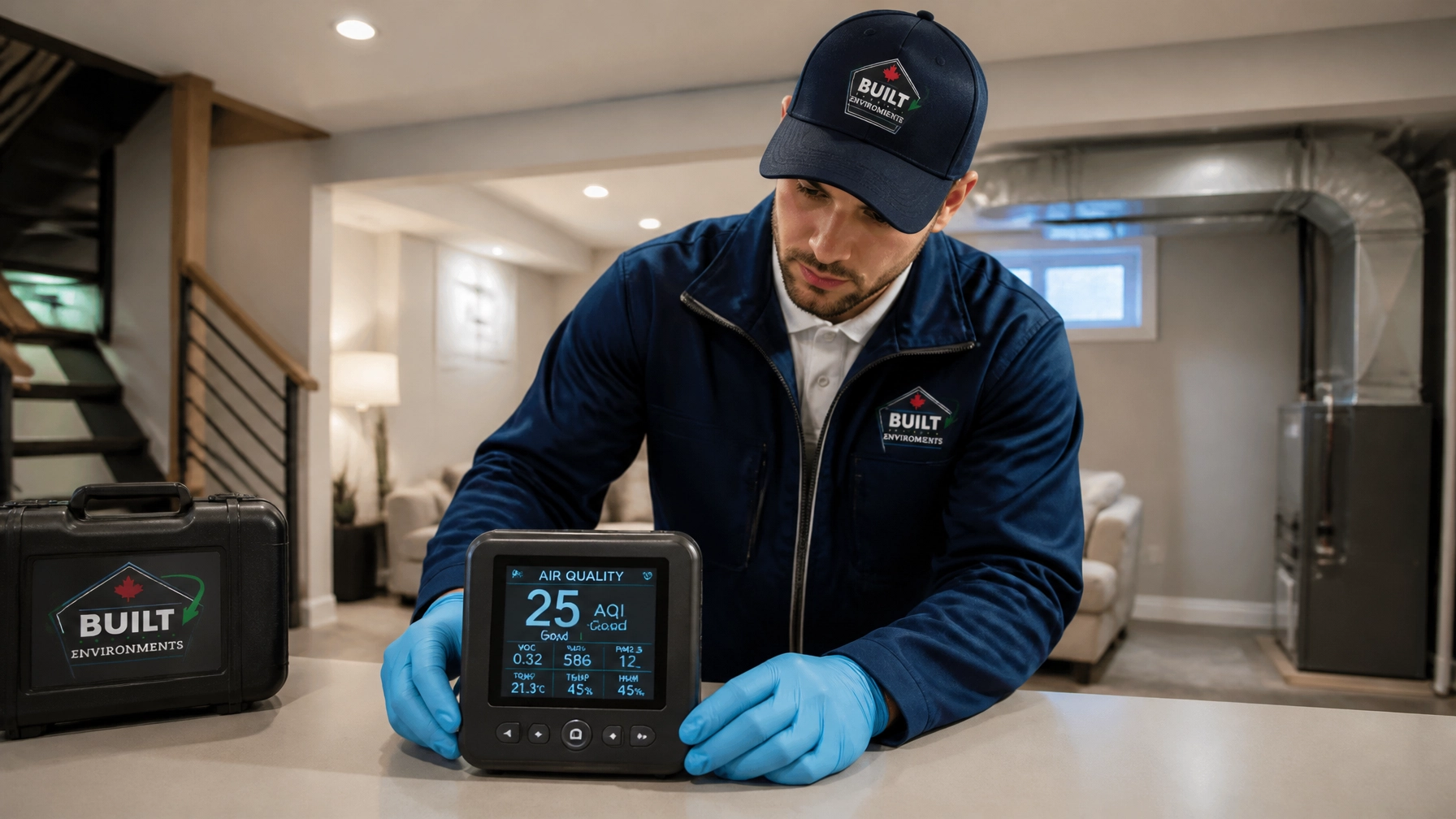
When you hire a professional, you aren't just buying a device; you’re buying expertise. We look at the building as a complete system. We don't just tell you the number; we explain why it’s happening and where the entry points are. If you are planning a renovation: especially in a pre-1990 home: understanding your baseline air quality is critical before you start sealing up walls or changing your HVAC system.
How does building science consulting improve the testing process?
Building science consulting goes beyond simple measurement by analyzing the interplay between your home’s structure, ventilation, and the surrounding environment. We use high-precision diagnostic tools to evaluate air pressure differentials and ventilation rates that influence how radon moves through your space. This holistic approach ensures that any recommended fixes actually work without accidentally causing other issues like backdrafting or moisture buildup.
At Built Environments Canada, our approach is rooted in data. We don't just guess; we measure. By looking at the "big picture" of your home's health: including indoor air quality and hazardous materials: we provide a roadmap for a safer environment. Whether you are a homeowner, a landlord, or a property manager, having a professional report in hand is an invaluable asset for long-term property value and occupant safety.
What happens if the test results come back high?
If your radon levels are high, the most common and effective solution is a sub-slab depressurization system, which vents the gas from beneath your home directly to the outside. This process involves installing a pipe through the foundation floor and a small fan that runs continuously to draw the radon out before it can ever enter your living space. Most professionally installed mitigation systems can reduce radon levels by over 90% and are relatively unobtrusive.

Don't let a high test result scare you. It’s a solvable problem. Once the system is in place, the air in your home is often fresher and drier, as these systems also help manage soil moisture. The goal is to return your home to being a sanctuary rather than a source of health anxiety. After mitigation, we always perform follow-up testing to verify that the levels have dropped below the target threshold.
Get a Professional Radon Assessment Today
Don't leave your family's health to chance. If you haven't tested your home for radon, or if you're concerned about your indoor air quality, our team is here to help. We provide clear, unbiased reporting and a scientific approach that delivers real peace of mind.
- Free 15-Minute Consultation: Talk to an expert about your concerns.
- Certified Professionals: Work with industrial hygiene and building science specialists.
- Fast Turnaround: Get the data you need to make informed decisions quickly.
Contact Built Environments Canada for a Quote
Key Takeaways
- Radon is Everywhere: It is a natural gas that affects 1 in 5 Canadian homes; testing is the only way to find it.
- Health Priority: As the leading cause of lung cancer in non-smokers, radon testing is a non-negotiable part of home safety.
- Know the Numbers: Health Canada recommends action at 200 Bq/m³, but lower is always better for long-term health.
- Trust the Pros: Professional testing offers the accuracy and building science context that DIY kits often miss.
- Fixable Problem: High levels can be effectively mitigated, making your home significantly safer for your family.