TL;DR: Building science treats your home as an interconnected system to balance energy efficiency with healthy, breathable air. Consulting with specialists ensures that modern insulation and sealing don’t accidentally trap harmful pollutants or moisture inside your living space.
What is the science behind your home’s air?
Building science is the study of how a building’s structure, systems, and environment interact to affect its performance and occupant health. It views a house as an integrated system where the roof, walls, windows, and HVAC must work together seamlessly. By using physics and chemistry to analyze airflow and moisture, building science helps create indoor environments that are both durable and safe.
When you think about your home, you might see a collection of separate parts: a furnace, some windows, and a few walls. However, a building science consultant sees these as a single, breathing entity. Every time you seal a window or add insulation to an attic, you change how air moves through the entire house. If the air can’t move, it can’t refresh. This is why we focus on the “Building Envelope”: the physical separator between the conditioned environment inside and the unconditioned environment outside.
At Built Environments Canada, our scientific approach means we don’t just look for a single problem. We look at how the whole system is failing or succeeding. Whether you are dealing with a drafty living room or a strange smell in the basement, the root cause is usually found in the interplay between these systems. Understanding this relationship is the first step toward achieving long-term peace of mind in your home.
Why does energy efficiency sometimes hurt air quality?
Energy efficiency focuses on “tightening” a home to stop heat loss, but this often reduces the natural ventilation needed to dilute indoor pollutants. Without a mechanical way to bring in fresh air, a highly sealed home can trap carbon dioxide, volatile organic compounds (VOCs), and excess humidity. Professional building science ensures that as we make homes tighter, we also make them smarter about air exchange.

For decades, the mantra in home renovation has been “seal it tight.” While this is great for your heating bill, it can be disastrous for your health if not managed correctly. In an older, “leaky” house, fresh air enters through cracks in window frames and gaps in the foundation. This natural leakage provides a constant, albeit uncontrolled, supply of fresh air. When we renovate and add high-performance windows and spray foam insulation, we essentially put a plastic bag over the house.
If you don’t install a balanced ventilation system, like a Heat Recovery Ventilator (HRV), the air inside becomes stagnant. Occupants begin to breathe in concentrated levels of chemicals from furniture, cleaning products, and even their own breath. According to Health Canada, indoor air can actually be more polluted than outdoor air. Our goal is to find that “sweet spot” where your home stays warm in the winter without becoming a pressure cooker for airborne contaminants.
What are the risks of DIY sealing without a professional plan?
The biggest risk of DIY air sealing is creating “dead zones” where moisture accumulates and triggers hidden mould growth. When homeowners seal up gaps without understanding pressure differentials, they can accidentally pull moist air into wall cavities or attics where it condenses on cold surfaces. This leads to structural rot and poor indoor air quality that can go unnoticed for years.
Many homeowners attempt to improve their comfort by using cans of spray foam or caulking to stop drafts. While well-intentioned, these DIY fixes often ignore how moisture travels. In a typical home, moisture is generated by showers, cooking, and even breathing. If you seal the exits but don’t provide a controlled exhaust, that moisture has to go somewhere. Often, it ends up trapped behind your drywall, creating the perfect environment for mould.
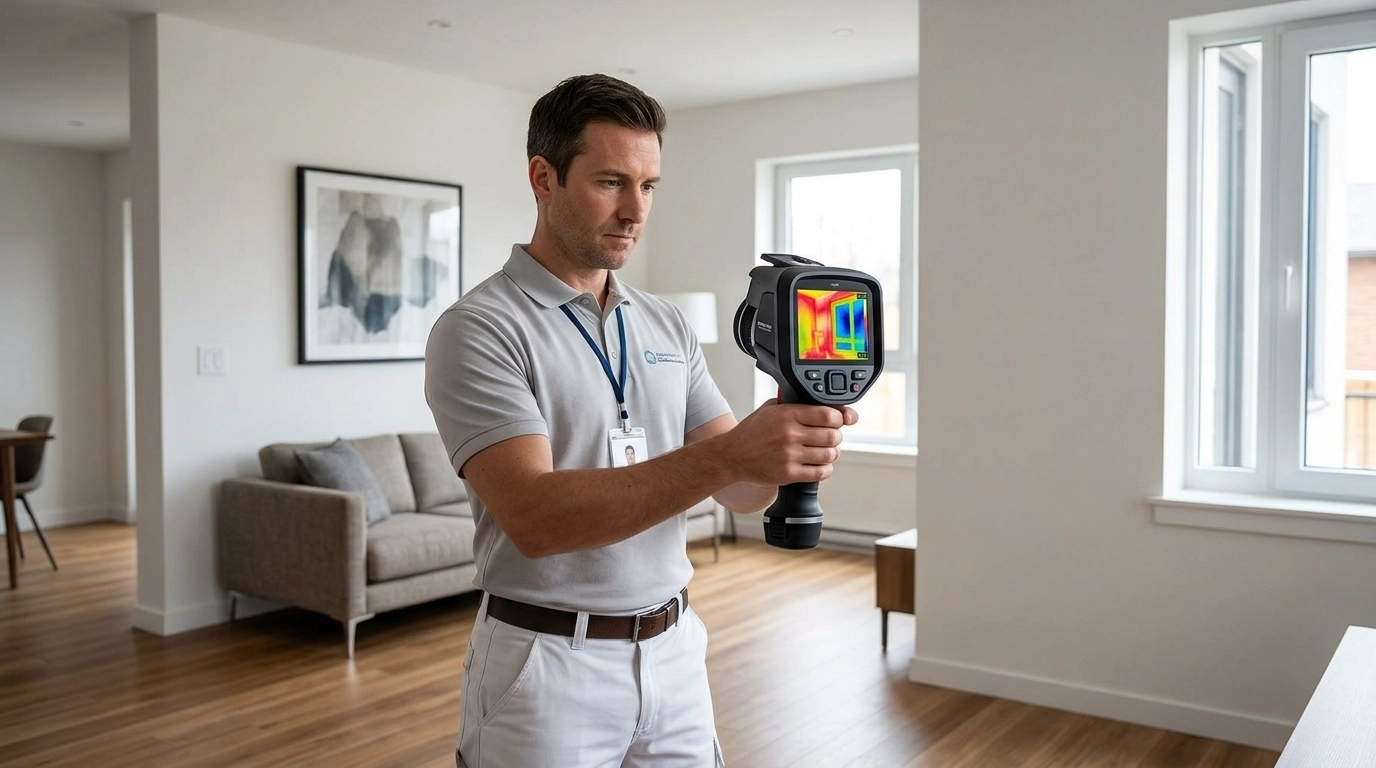
Once mould takes hold inside a wall, it releases spores and mycotoxins into your living space every time the furnace kicks on. You might start noticing headaches, respiratory issues, or a persistent “musty” smell. By the time you see the black spots on the wall, the damage is already extensive. Consulting with a Certified Industrial Hygienist (CIH) before you start sealing can save you thousands of dollars in future remediation costs. We use tools like thermal imaging to see where moisture is hiding before it becomes a hazard.
Why are hazardous materials a critical part of building health?
Hazardous materials like asbestos and lead are frequently disturbed during energy-efficiency upgrades or renovations, posing immediate health risks. In homes built before 1990, these materials are often hidden in the very areas people target for “tightening,” such as attic insulation, duct wrap, and old window caulking. Identifying these substances before you start work is the only way to ensure your indoor air remains safe during and after the project.

It is a common misconception that hazardous materials are only found in commercial buildings or extreme “fixer-uppers.” In reality, asbestos was used in over 3,000 different building products, ranging from floor tiles to popcorn ceilings. If you decide to replace your old insulation to save on energy, you might be disturbing vermiculite that contains asbestos. This is why asbestos testing is mandatory for many renovations: it’s not just a regulation; it’s a life-saving precaution.
Similarly, lead-based paint was common in Canadian homes for decades. Even a small amount of dust from sanding an old door frame can cause lead poisoning, which is particularly dangerous for children and pregnant women. Understanding how lead paint testing works is essential for any homeowner planning a refresh of their space. At Built Environments Canada, we integrate this testing into our broader building science assessments to help you avoid the biggest hazardous material pitfalls.
How do Certified Industrial Hygienists provide peace of mind?
Certified Industrial Hygienists (CIHs) use a scientific, evidence-based approach to quantify exactly what is in your air and how to fix it. Unlike a general contractor who might guess at a solution, a CIH uses calibrated equipment to measure particulates, gases, and biological agents. This results in an unbiased report that gives you a clear roadmap to a healthier home environment.
The term “industrial hygiene” might sound like it’s only for factories, but the principles apply perfectly to your living room. We are specialists in identifying seen and unseen airborne contaminants that affect your productivity and health. When we visit your home, we don’t sell products; we provide data. This independence is crucial because it means our recommendations are based on science, not on trying to sell you a new furnace or a mould cleaning service.
Working with a CIH means you get a fast turnaround and clear, jargon-free reporting. We understand that environmental concerns can be stressful. Whether you are buying a new home and want a “baseline” air quality test, or you are a property manager dealing with a tenant complaint, we provide the responsive service you need. Our goal is to deliver peace of mind through a scientific lens, ensuring that every breath you take in your home is a healthy one.

Get a Professional Building Science Assessment
Are you worried about the air quality in your home or planning a major renovation? Don’t leave your health to chance. Built Environments Canada offers expert consulting to help you understand your home’s unique environment.
- Free 15-Minute Initial Consultation: Speak with an expert to discuss your concerns.
- Certified Professionals: Our team includes Certified Industrial Hygienists.
- Scientific Approach: Data-driven results you can trust.
Contact Us Today to Get a Quote
Key Takeaways
- Systems Thinking: Your home is an interconnected system where changes to one part (like insulation) affect everything else (like air quality).
- Ventilation is Vital: A “tight” house must be a “ventilated” house to prevent the buildup of indoor pollutants and humidity.
- Hidden Hazards: Before you renovate or seal gaps, test for asbestos and lead to ensure you aren’t releasing dangerous fibers or dust.
- Expert Guidance: Working with a Certified Industrial Hygienist provides unbiased, scientific proof of your home’s safety.
- Prevention Over Cure: Professional building science consulting identifies moisture and air issues before they turn into expensive mould problems.