TL;DR: Lead paint testing is essential for any Canadian home built before 1990 to prevent toxic dust exposure during renovations. Professional testing using XRF technology is the only reliable way to identify lead hazards and ensure your project stays safe and legally compliant.
Renovating an older home is an exciting milestone, but in Canada, it often comes with a hidden guest: lead. If you are planning to tear down a wall, sand a window frame, or strip old siding in a house built before 1990, you need to think about what is lurking under those layers of beige paint. Lead is a powerful neurotoxin, and disturbing it without a plan can turn a dream renovation into a health nightmare for your family.
At Built Environments Canada, we help homeowners and property managers navigate these invisible risks. Lead isn't just a "vintage" problem; it’s a modern safety requirement. Here are 10 things you need to know about lead paint testing before you pick up a sledgehammer.
1. Why are pre-1990 homes considered high risk?
Homes built before 1990 often contain lead-based paint because it was widely used for its durability and moisture resistance. While the most dangerous levels were found in houses built before 1960, lead was still present in many interior and exterior paints until the late 1980s. Even if your home looks modern, those old toxic layers are likely buried deep beneath newer, safer coats of paint.
In Canada, the transition away from lead was a slow process. If your home was built in the early 20th century, the concentration of lead could be as high as 50% by weight. By the 1970s, the levels dropped, but they remained high enough to cause health issues if inhaled as dust. This is why any pre-1990 building should undergo hazardous material identification before any disturbance occurs.
2. What is Health Canada’s stance on lead exposure?
Health Canada explicitly states that there is no known safe level of lead exposure for humans. Even very small amounts of lead can build up in the body over time, causing permanent damage to the brain, nervous system, and kidneys. Children and pregnant women are at the highest risk because lead interferes with developing bodies and can lead to learning disabilities and behavioral issues.
Because there is no "safe" amount, the goal of lead paint testing is to identify any presence of the metal so it can be managed with zero-exposure goals. When you renovate, lead paint is ground into microscopic dust that can hang in the air for days or settle into carpets where it is easily ingested by toddlers.

3. What is the 90 mg/kg limit?
The Surface Coating Materials Regulations in Canada set a strict limit of 90 mg/kg (or 90 parts per million) for lead in new consumer paints. This regulation, updated significantly in 2010, ensures that any paint you buy today is virtually lead-free. However, this limit is also the benchmark used by professionals to determine if existing paint in an older home is considered "lead-containing" or "lead-based."
If a laboratory test or XRF scan shows lead levels above this threshold, the material must be handled with specific safety protocols. Understanding this number is key because many older Canadian homes have layers that exceed this limit by thousands of milligrams. You can find more details on these federal limits via the Government of Canada’s safety resources.
4. Professional XRF vs. Lab Testing vs. DIY Kits: Which is best?
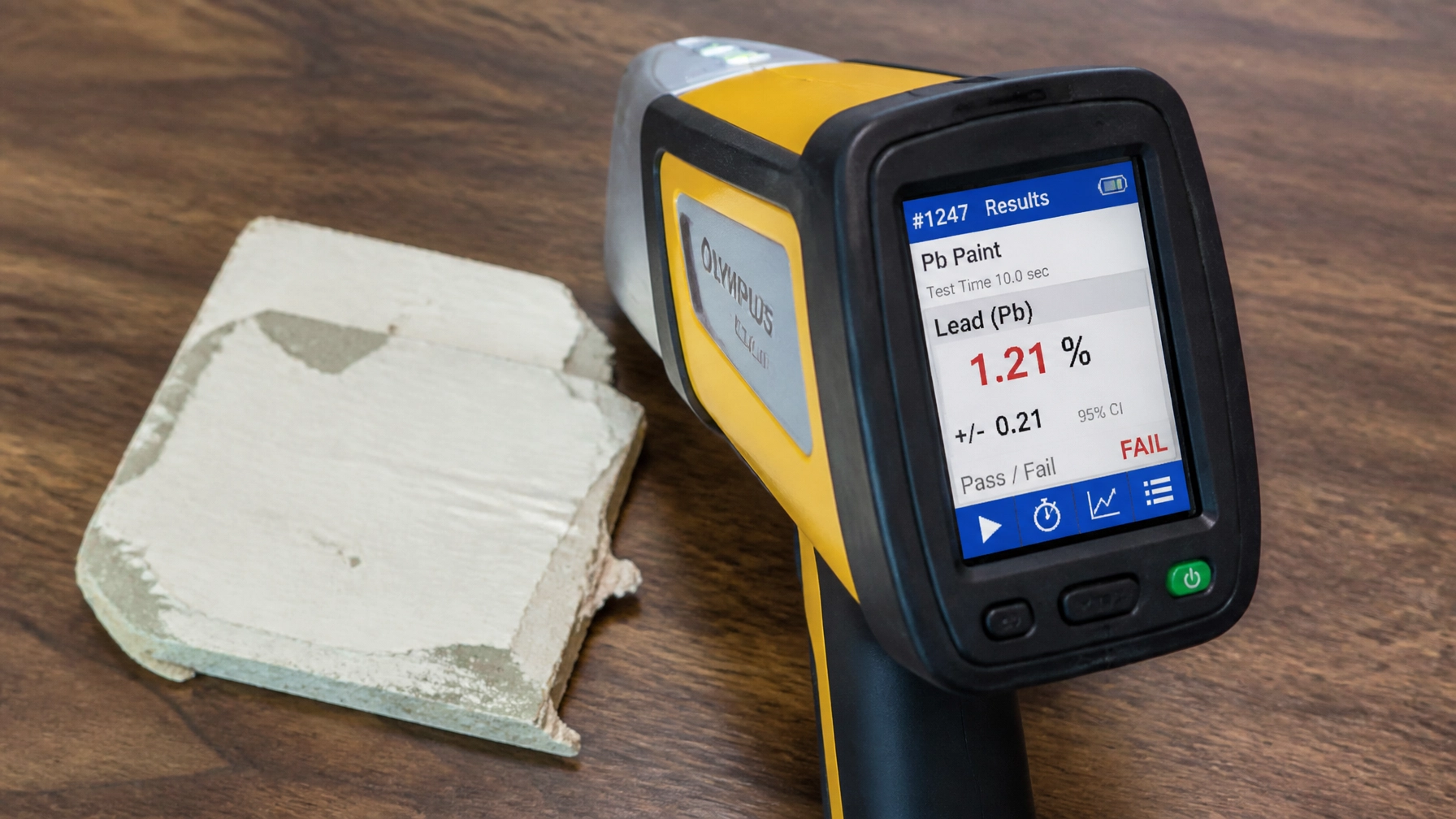
Professional X-Ray Fluorescence (XRF) testing is the gold standard because it provides instant, non-destructive results without damaging your walls. While DIY kits are cheap and available at hardware stores, they are often unreliable, producing "false negatives" if the lead is buried under newer paint. Lab testing is highly accurate but requires cutting out physical "chips" of your wall and waiting days for a report.
At Built Environments Canada, we prefer XRF technology. It allows us to scan every room in your house in minutes. We can tell you exactly which walls are safe and which ones require caution without leaving a single mark on your finishes. If you are serious about safety, skip the $20 swab kit and opt for a professional survey that actually looks through the layers.
5. What is a pre-renovation hazardous material survey?
A pre-renovation survey is a comprehensive inspection performed by a consultant to identify lead, asbestos, and other hazards before work starts. This isn't just a "walk-through"; it’s a scientific assessment that results in a detailed report. This report tells your contractor exactly where the hazards are located so they can price their work accurately and protect their crew.
In many jurisdictions, including Ontario, having this survey completed is actually a legal requirement for property owners. If you hire a contractor and they disturb lead or asbestos because you didn't provide a survey, you could be held liable for the cleanup costs and health damages.

6. What are "lead-safe" renovation practices?
Lead-safe practices focus on three pillars: dust containment, wet methods, and HEPA filtration. Instead of dry sanding (which creates clouds of toxic dust), professionals use wet scraping or "shrouded" tools attached to high-efficiency particulate air (HEPA) vacuums. The work area is usually sealed off with heavy-duty plastic sheeting to prevent dust from migrating to the rest of the house.
If your contractor shows up with a standard shop-vac and a regular sander, stop the work. A standard vacuum will simply suck up lead dust and blow it out the exhaust, spreading it everywhere. True lead-safe work requires specialized equipment and a "work wet" philosophy to keep the heavy metal on the ground and out of your lungs.
7. Do I need post-renovation clearance testing?
Clearance testing is a final check performed after the renovation to ensure the cleaning was successful and no lead dust remains. This usually involves taking "wipe samples" from floors and window sills, which are sent to a lab for analysis. It is the only way to prove that the home is truly safe for your family to move back into.
Many homeowners skip this step to save money, but it is the most important part of the process for peace of mind. Even the best contractors can miss a corner. A final clearance test ensures that the "invisible" dust left behind isn't going to affect your indoor air quality.

8. What are Ontario’s "Designated Substance" rules?
In Ontario, lead is classified as a "Designated Substance" under Regulation 490/09, which carries strict legal requirements for workplace safety. If you are a property manager or a business owner, you are legally obligated to identify lead before any construction or demolition project. Failing to do so can result in massive fines from the Ministry of Labour and immediate work-stoppage orders.
Even for homeowners, these rules set the standard for how contractors should behave. A reputable Ontario contractor will insist on seeing a lead and asbestos report before they start, as it protects their workers' health and their own legal liability.
9. How do I dispose of lead-painted waste?
Lead-painted materials are often classified as hazardous waste and cannot simply be thrown in a standard renovation bin. Depending on your local municipal rules, large amounts of lead-contaminated debris (like old siding or windows) may require "leachate testing" to determine if they need to go to a specialized hazardous waste landfill.
Throwing lead-based paint chips or dust into the regular trash can lead to environmental contamination. Always check with your local waste management authority or your environmental consultant to ensure you are following the rules for hazardous material disposal.
10. How can Built Environments Canada help?
We provide expert, unbiased lead paint testing and building science consulting to ensure your home is a healthy place to live. We don't do the removal ourselves, which means our reports are completely objective. We aren't trying to sell you an expensive remediation package; we’re giving you the hard data you need to make a smart decision.
Whether you are a homeowner worried about a nursery renovation or a property manager planning a large-scale demolition, we offer a scientific approach that delivers peace of mind. We can identify lead, evaluate your indoor air quality, and guide you through the safety regulations.
Get a Quote Today
Don't guess when it comes to your family's health. If you're planning a renovation, start with the facts.
Book a free 15-minute initial consultation with our specialists here.
Key Takeaways
- Assume lead is present in any Canadian home built before 1990 until you have proof otherwise.
- Use professional XRF testing for the most accurate, non-destructive results that look through all layers of paint.
- Contain the dust using HEPA vacuums and wet methods; never dry-sand suspected lead paint.
- Get a clearance test after the work is done to verify that no toxic residues were left behind.
- Consult a professional if you are unsure about Ontario’s Designated Substance regulations or federal safety limits.